

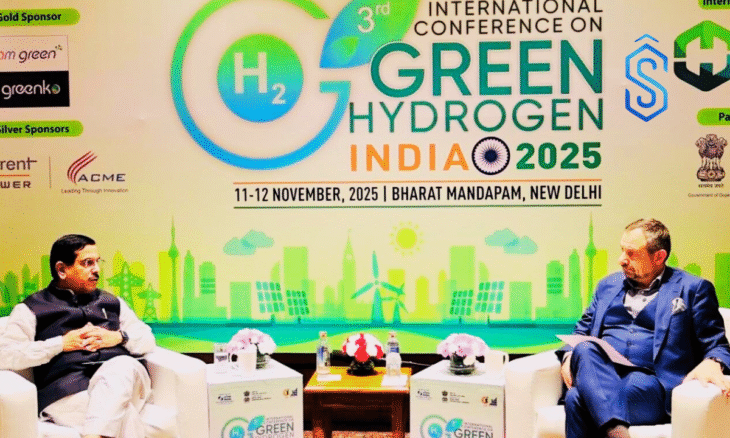
New Delhi: Union Minister for New & Renewable Energy, Pralhad Joshi, announced a ₹100 crore call for proposals for Biomass-Based Hydrogen Pilots under the National Green Hydrogen Mission (NGHM).
The initiative, launched during the 3rd International Conference on Green Hydrogen (ICGH 2025) at Bharat Mandapam, New Delhi, aims to develop innovative technologies for producing green hydrogen from biomass and waste materials, advancing India’s clean energy transition.
Biomass-Based Hydrogen Pilots to Boost Green Innovation
The new ₹100 crore scheme for Biomass-Based Hydrogen Pilots will be implemented through the Biotechnology Industry Research Assistance Council (BIRAC).
Also Read: Purine Molecules Enhance Hydrogen Production from Water by 4x, Cutting Platinum Costs
It seeks participation from start-ups, industries, and research institutions to build an innovation-driven ecosystem for sustainable hydrogen production. The Minister noted that this initiative complements the ₹100 crore already sanctioned for start-ups under the NGHM.
Biomass-Based Hydrogen Pilots: Clean Energy Transition
Joshi reaffirmed that the National Green Hydrogen Mission (NGHM) – launched in 2023 with an outlay of ₹19,744 crore – is catalysing India’s shift toward clean energy, creating employment, and attracting investments. He said the Mission is positioning India as a global hub for green hydrogen while promoting indigenous technological advancement.
Under the Strategic Interventions for Green Hydrogen Transition (SIGHT) programme, incentives have been granted for 3,000 MW per annum of domestic electrolyser manufacturing and 8.62 lakh metric tonnes per annum of green hydrogen production. India now records the world’s lowest green ammonia price at ₹49.75 per kg for 7.24 lakh MTPA production.
Biomass-Based Hydrogen Pilots: Investments, Jobs, and Global Competitiveness
Highlighting the broader economic impact, Santosh Kumar Sarangi, Secretary, MNRE, said the Mission is projected to mobilise over ₹8 lakh crore in investments, create six lakh jobs, and save ₹1 lakh crore annually in fossil-fuel imports.
He added that India’s installed non-fossil capacity has exceeded 250 GW, including 130 GW of solar, 50 GW of wind, and 17 GW of bio-energy and small hydro.
The Minister also unveiled the official logo of the NGHM, chosen from more than 2,500 public entries, representing India’s collective commitment to sustainability and innovation.
He emphasised that the Mission is more than a national initiative—it represents a global solution to decarbonise hard-to-abate sectors and ensure long-term energy independence.
Also Read: Deendayal, V O Chidambaranar, Paradip Ports Named as Green Hydrogen Hubs by MNRE
Biomass-Based Hydrogen Pilots: Strengthening Skills and Standards for Hydrogen Ecosystem
India is also expanding its skills and standards framework for green hydrogen. To date, 43 hydrogen-related skill qualifications have been approved, and over 6,300 trainees have been certified.
The Green Hydrogen Standard (2023), Certification Scheme (2025), and 128 technical standards are helping to shape a robust regulatory and quality ecosystem.
India’s Low-Cost Advantage in Global Hydrogen Markets
Prof. Ajay K. Sood, Principal Scientific Adviser to the Government of India, said that India’s low-cost production advantage could make it a key exporter of green hydrogen to markets such as the European Union, Japan, and South Korea.
He added that the NGHM is progressing across its four strategic pillars—policy, demand creation, research and development, and infrastructure development.
The International Conference on Green Hydrogen (ICGH 2025) also saw participation from Jorgo Chatzimarkakis, CEO, Hydrogen Europe, and Akash Tripathi, Managing Director, SECI, marking a global collaboration platform for hydrogen innovation and policy dialogue.